


Find YOUR path
How to use ASCENT
Simple, reliable, meaning-ful & evolving scales help walkers find the trail right for them. Read more.
Helps meet health goals using our research-based Progressive Access framework. Read more.
Helps park managers and funders prioritize trail & other improvements to increase access. Read more.
Don't forget to check out the Overview of the ASCENT Rating System here.
General Considerations
The design of ASCENT is driven by the need for ratings that are meaningful
-
An A Rating is consistent with UA Standards, the baseline recognized as facilitating access for all users regardless of the type of level of disability.
-
Thresholds for increasing levels of Trail Stress are selected to help people with disabilities take their first steps on natural trails, and then over time select incrementally more challenging trails to build their fitness, skills, and confidence


The design of ASCENT is also driven by the need for ratings that are as simple as possible because this makes it easier for
-
Raters to complete the survey as quickly and as reliably as possible
-
Walkers to confidently visualize how difficult a trail might be when they are setting goals or planning an outing
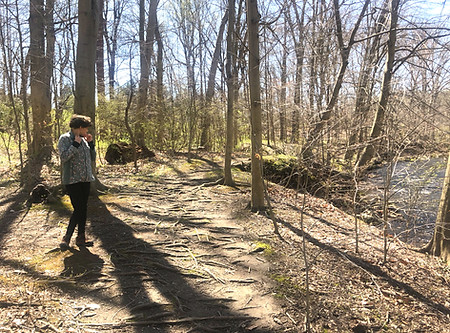
These long sections of obstacles build Margot's capacity, bringing her to a peaceful spot in White Clay Creek Preserve she might otherwise not reach.
Rather than capturing every stressor along a trail's length, ASCENT seeks to capture shifts in the maximum stress encountered for a given feature from a given trailhead to help people identify trails that they will be comfortable on given their skills and goals.
Characterizing Trail Stress
Stress level
Is described relative to the Universal Access standards
-
A- Falls just short of UA standards
-
B Clearly exceeds UA standards
-
C Significantly exceeds UA standards (e.g., a C rating) with respect to a specific feature

Length of stressor
-
Less than 10' (shorter)
-
More than 10' (longer)
A hiker seeking to build their skills and confidence may prefer tackling a trail that presents multiple shorter sections that allow them to rest / reset in between sections with more significant stressors.
Note that sections separated by less than 4' are counted as part of the same section... consider these examples of involving sections of trail 2' long and 2' wide (a B rating)
-
2 2' sections separated by 4' would be counted as 2 shorter sections
-
2 2' sections separated by 3' total are counted as one shorter (7' long) section
-
3 2' sections each separated by 3' are counted as one longer (2'+3'+2'+3'+2'=12') section\
Combined stressors
The combination of stressors within a specific section may be particularly challenging depending on a person's disability. For example a wheelchair user
-
May be somewhat confident navigating a section of trail with a 5-10% cross grade
-
May be somewhat confident navigating a 10+' long section of trail a running grade downhill of almost 20%
-
But may have no confidence when faced with a section combining these stressors, so choose to turn around.
Maximum stress level
-
Trail maps and descriptions include the maximum stress rating encountered for a hiker who completes the entire trail for each feature
-
Maps also indicate the point on the trail where stress rating increases for a given feature (for example, from Very Easy to Very Easy to Easy for Width) so that a hiker might decide that a trail is worth trying even if they have to turn around
Maximum cumulative stress
It is not only difficult to characterize every feature of a trail that exceeds UA standards, it is unnecessary
-
A+ Asphalt, concrete, or boardwalk
-
A Gravel surface that is clear, firm, and stable
-
A- Grass or dirt surface that is:
-
Clear;
-
Generally firm - e.g., a footprint will not have than a 1/2" rim and a 2" wide wheel will not leave a rut more than 1" deep), and;
-
Generally stable - e.g., except after exceptionally prolonged or significant rainfall
-
-
B Generally clear, but includes up to 3 30' sections that are not firm and stable - e.g., a foot may sink up to 1" with or a bicycle / wheelchair / stroller wheel up to 2"
-
C Falls short of the criteria above
Survey development process
RATINGS Read more here
-
A+ Asphalt, concrete, or boardwalk
-
A Gravel surface that is clear, firm, and stable
-
A- Grass or dirt surface that is:
-
Clear;
-
Generally firm - e.g., a footprint will not have than a 1/2" rim and a 2" wide wheel will not leave a rut more than 1" deep), and;
-
Generally stable - e.g., except after exceptionally prolonged or significant rainfall
-
-
B Generally clear, but includes up to 3 30' sections that are not firm and stable - e.g., a foot may sink up to 1" with or a bicycle / wheelchair / stroller wheel up to 2"
-
C Falls short of the criteria above
Training process
RATINGS Read more here
-
A+ Asphalt, concrete, or boardwalk
-
A Gravel surface that is clear, firm, and stable
-
A- Grass or dirt surface that is:
-
Clear;
-
Generally firm - e.g., a footprint will not have than a 1/2" rim and a 2" wide wheel will not leave a rut more than 1" deep), and;
-
Generally stable - e.g., except after exceptionally prolonged or significant rainfall
-
-
B Generally clear, but includes up to 3 30' sections that are not firm and stable - e.g., a foot may sink up to 1" with or a bicycle / wheelchair / stroller wheel up to 2"
-
C Falls short of the criteria above